

Growing a meaningful online footprint is no longer about publishing a handful of well-written pages and waiting for rankings. Today, brands and publishers are competing across two parallel systems:
Search engines, which still index pages, keywords, and links
LLM-driven discovery, where answers are built from conversations, context, and repeated brand mentions across the web
The real challenge is operational. Creating sites, feeding them content, keeping it structured, publishing consistently, and monetising the result usually means stitching together multiple tools, workflows, and people.
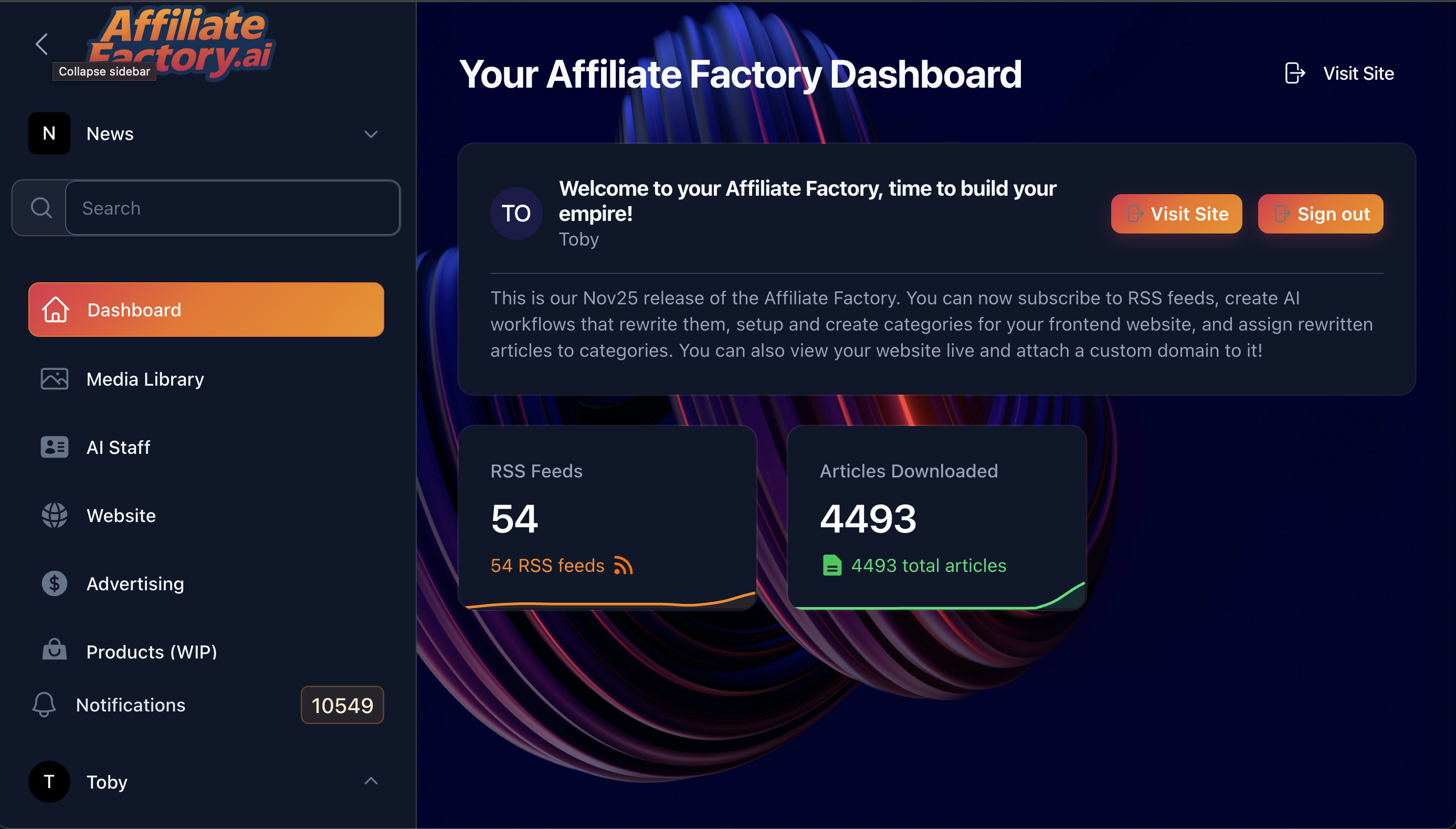
In this demo, we walked through how AffiliateFactory.ai acts as a single control layer for all of that from site creation, to content workflows, to monetisation without requiring users to be developers, SEO specialists, or CMS experts.
What was demonstrated in this session
In a live walkthrough with a prospective user, we covered how AffiliateFactory can be used to:
Spin up a brand-new content site in minutes
Customise branding, layout, and tracking without touching code
Pull in third-party content via RSS feeds
Rewrite and structure that content using defined editorial workflows
Publish clean, metadata-ready articles and pages
Add monetisation through banners, promotions, and product imports
Prepare content for both Google indexing and LLM discovery
All examples were shown using a blank installation, to reflect what a new user would see from day one.
How AffiliateFactory works (end to end)
1. Create a Factory (site instance)
Each project starts by creating a “factory”, which is effectively a new website under your account. It launches as a clean canvas with a homepage, navigation structure, light and dark mode support, and a default subdomain that can later be mapped to your own domain.
This removes the usual friction of hosting setup, CMS installs, and theme configuration.
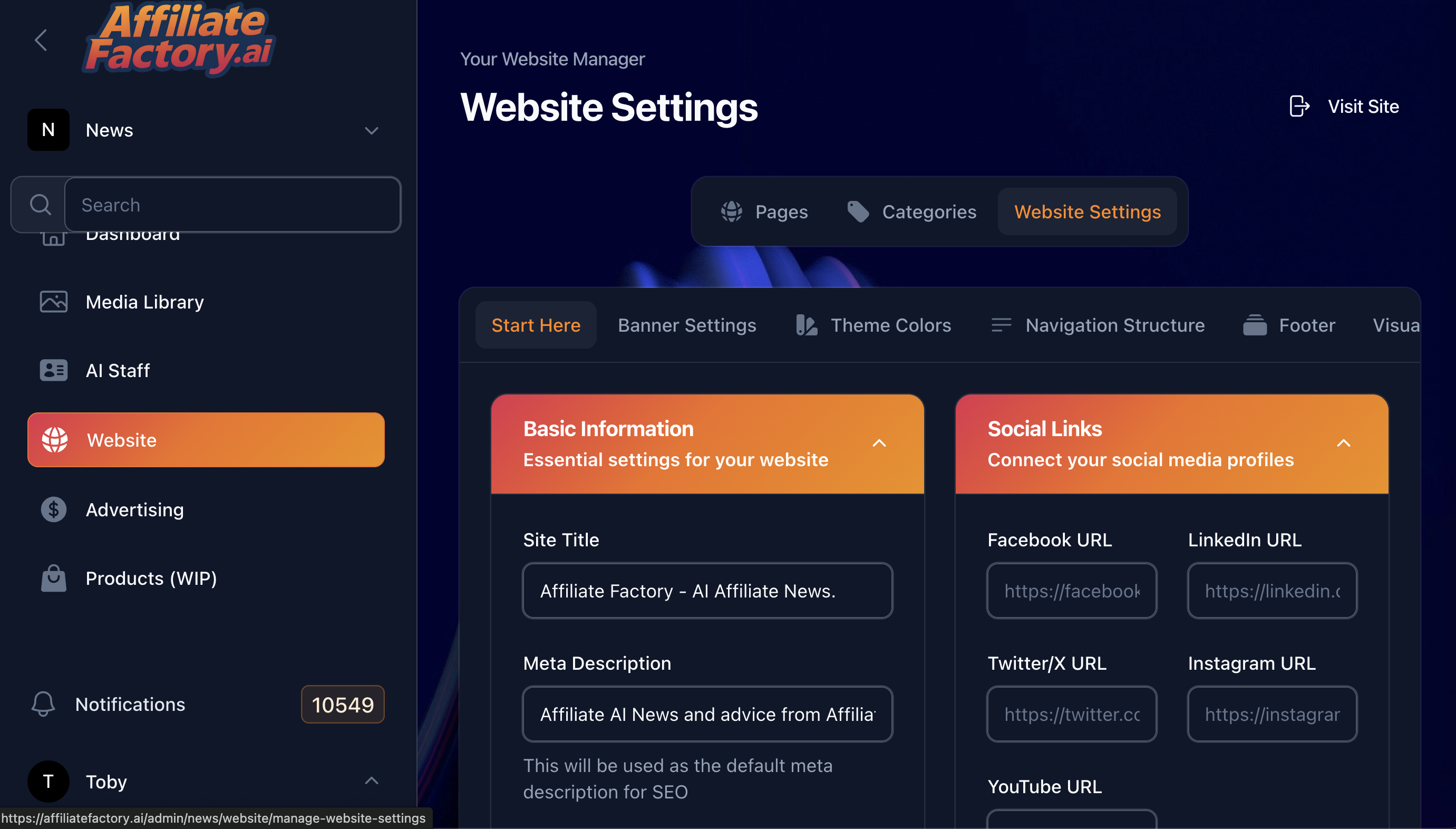
2. Configure the website
From the settings panel you can define:
Site title and brand identity
Logo and social links
Fonts and colour themes (light and dark modes)
Navigation and footer structure
Banner placements
Tracking scripts such as analytics or tag managers
The focus here is speed and clarity. You can see changes instantly and keep the site simple by design.
3. Define author workflows (editorial control)
Instead of a single generic content generator, AffiliateFactory allows you to create multiple author profiles, each with its own rules.
An author profile can include:
Writing style (technical, formal, editorial, etc.)
Tone (neutral, enthusiastic, authoritative)
Explicit writing instructions and exclusions
A stricter master prompt that governs structure, formatting, SEO signals, FAQs, and summaries
This means the same source material can be rewritten differently depending on intent for example, as an editorial article, a thought-leadership piece, or commercially focused content.
4. Ingest content via RSS
RSS feeds can be added for any relevant publication or source. Once synced, the system:
Pulls in recent articles
Validates structure and usability
Flags content that is ready for processing
This creates a controlled inbox of source material rather than a firehose of unchecked content.
5. Apply workflows and generate drafts
With one action, selected items can be processed through an author workflow.
The output is generated as a draft, not auto-published. Drafts typically include:
Cleanly structured content
Key takeaways for skim readers and LLMs
FAQ sections where appropriate
Removal of unwanted references or competitors
This is where operational leverage appears: intake, transformation, and enrichment become repeatable.
6. Edit and publish
Drafts open in a simple editor where you can:
Make manual edits
Add categories and tags
Upload a featured image
Define SEO titles and meta descriptions
Choose whether the content is an article or a page
This supports a hybrid model: human-written cornerstone content alongside workflow-driven supporting articles.
7. Monetise with promotions and banners
Monetisation is handled in two layers:
Promotions: what you’re promoting (offers, products, services)
Placements: where those promotions appear on the site
Banners can be created directly in the platform using text, colours, and gradients, or you can embed third-party creatives if you have them. Once enabled, placements go live instantly across the site.
This removes dependency on external design assets at early stages.
8. Import products by URL
Products can be imported directly from a URL. The system reads the page and creates a product record containing:
Title and description
Pricing and currency
Product type (digital, physical, subscription)
Tags and identifiers
Images where available
From there, content can be generated around the product using any author workflow, including comparison or buyer-guide formats.
Google indexing vs LLM discovery
Traditional SEO is page-centric. It focuses on keywords, links, and authority.
LLM discovery works differently. It looks for:
Structured explanations
Repeated brand and concept mentions across contexts
FAQs, summaries, and comparisons
Content that fits naturally into an answer, not just a ranking
AffiliateFactory is designed to sit between these two systems. It helps users create content that still works for Google, while also feeding the structures and signals that AI-driven search and assistants rely on.
Who this is built for
AffiliateFactory consistently fits three profiles:
Solo builders and small teams who want an online asset without CMS complexity
Established affiliates expanding into new niches, regions, or content formats
Publishers and brands that want to own their media footprint end to end
It’s not tied to one vertical and doesn’t require deep technical knowledge to operate.
Key takeaways
New content sites can be launched and branded quickly
Editorial control is enforced through reusable workflows
RSS feeds become structured content pipelines, not noise
Draft-first publishing supports quality and compliance
Monetisation is native, flexible, and optional
Content is structured for both search engines and LLMs
FAQs
Is this safe for SEO?
Yes, when used correctly. Content is generated as drafts, and differentiation is driven by workflow rules and editorial framing rather than raw paraphrasing.
How does it avoid duplicate content issues?
By adding structure, intent, summaries, FAQs, and unique framing rather than republishing sources verbatim.
Can this support low-volume, high-quality sites?
Absolutely. Workflows can be strict, and publishing cadence is entirely under your control.
Can content be used outside the platform?
Yes. Content can be copied today, with direct CMS and social connectors planned.
Is editorial review required?
Strongly recommended. The platform accelerates production, but quality control remains a human decision.
Editorial & compliance note
Content is generated draft-first. Editorial review is recommended before publication. AffiliateFactory is designed to add structure, differentiation, and operational leverage.
Next steps
If you want to explore how this workflow fits your own use case:
Book a call to walk through it live
Join the WhatsApp community to see how others are using the platform and shaping upcoming features